If your home sits over a crawlspace, the air down there does not stay down there. As warm air rises through the house, it pulls air up from below, carrying moisture, musty odors, and mold spores into the rooms you live in. That is why crawlspace moisture shows up as damp floors, sticky summers, and a smell you cannot quite place.
Homeowners usually hear about two fixes: a vapor barrier and full encapsulation. They are related, but they are not the same job, and picking the wrong one can mean paying twice.
What a vapor barrier does
A vapor barrier is a sheet of polyethylene laid over the dirt floor of the crawlspace. Bare soil constantly releases moisture into the air, and the barrier stops most of that evaporation at the source.
- Best for crawlspaces that are dry, with no standing water or flooding
- Reduces ground moisture, but leaves the vents open to outside air
- Lower upfront cost and a quicker install
- Thicker material holds up better to foot traffic from service techs
The limitation is the vents. In the humid DC and Maryland summer, outside air carries a lot of moisture. When it flows into a cooler crawlspace, it can condense on ductwork, pipes, and the underside of the floor, even with a barrier on the ground.
What encapsulation does
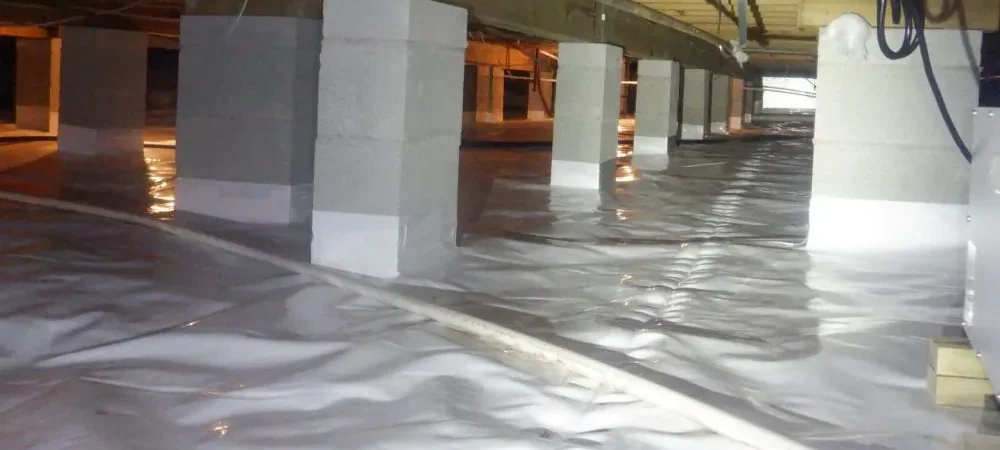
Encapsulation turns the crawlspace into a sealed, conditioned part of the house. The floor and the walls are lined with a heavy-duty liner, seams are taped, the vents and openings to the outside are sealed, and the space is kept dry with a dehumidifier or conditioned air.
- Controls moisture from the ground and from outside air
- Helps protect wood framing, insulation, and ductwork from rot and condensation
- Can make the floors above feel warmer and the house less humid
- Keeps pests and outside debris out of the space
Water first, then the liner
Neither option is a fix for a crawlspace that floods. A liner over standing water just hides the water. If water is collecting after storms, it has to be managed first, usually with a perimeter drain and a sump pump, and with the gutters, downspouts, and grading outside checked so less water reaches the foundation in the first place.
How to choose
A few questions get most homeowners to the right answer:
- Is there standing water, or mud after rain? Fix drainage first.
- Is there visible mold, wet insulation, or condensation on ducts? Encapsulation is usually the better fit.
- Do the floors above feel cold, or is the house humid all summer? Encapsulation tends to help both.
- Is the crawlspace dry with only a damp dirt floor? A vapor barrier may be enough.
What an inspection looks at
When we inspect a crawlspace, we check moisture levels in the framing, look for signs of standing water, evaluate the vents and the condition of the insulation and ductwork, and look outside at gutters and grading. That tells us whether a barrier will hold, or whether the space needs to be sealed and dried.
Learn more about our crawlspace encapsulation and vapor barrier installation services, or request an inspection to find out which one your home needs.