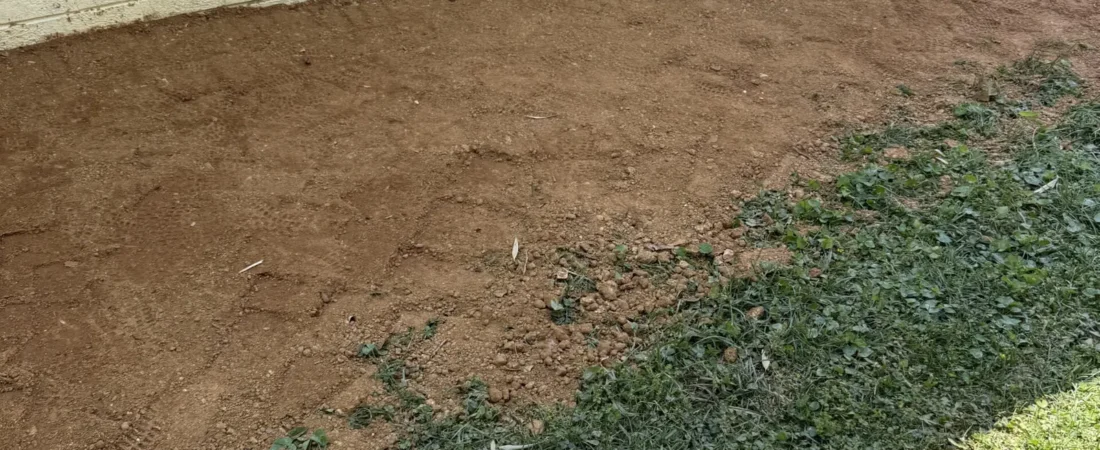
Your home’s first line of defense against water is right under your feet. Before a drop of rain reaches your foundation wall, it lands on the roof and the yard, and what happens in the next ten feet decides whether it drains away or soaks into the soil against your basement. Poor grading and ineffective exterior drainage are the hidden cause behind a large share of the leaks we are called to fix.
The grading rule that matters
The ground next to your house should slope away from the foundation by at least six inches over the first ten feet. That is roughly a half-inch of drop for every foot. It sounds minor, but it is the difference between rainwater running off into the yard and rainwater pooling against the wall and sinking straight down.
On many older DC and Maryland properties, the grade has reversed over the years. Soil settles against the foundation, mulch beds build up, patios and walkways are poured flat, and a lawn that once drained now funnels water toward the house. Narrow rowhouse side yards and the uphill side of a sloped lot are the usual trouble spots.
How we correct grade
Re-grading is not just adding dirt. We remove the soil against the foundation to check for cracks and failed waterproofing, then rebuild the slope with compacted fill that sheds water, topped with soil that will hold grass or plantings. Where a walkway or patio is pitched toward the house, we address that too, because concrete that drains the wrong way defeats everything around it.
On a tight lot where there is no room for a six-inch drop, we use a swale or a shallow channel drain to intercept water and carry it to a point where it can be released or collected.
Downspouts: the most common fix
A single downspout can deliver hundreds of gallons of water during one heavy storm. If it ends at a splash block a foot from the wall, all of that water is going into the soil next to your foundation. Downspouts should discharge at least six feet from the house, and farther on flat ground or clay.
- Surface extensions are the simplest fix, but they get kicked, mowed over, and disconnected
- Buried downspout lines carry water underground to a pop-up emitter, dry well, or cistern and stay out of the way
- Gutters need to be sized, pitched, and clear; an overflowing gutter is a downspout that empties at the wall
- Old clay or cast-iron downspout drains in rowhouses are often broken underground, so a camera inspection tells you whether they still work
Yard drainage for the water that is left
Grading and downspouts handle roof water and surface runoff. For yards that stay soggy, low spots that pool, or water that arrives from a neighbor’s lot, we add drainage: a shallow French drain to collect water along a problem line, a catch basin at a low point, or a dry well or cistern that holds a storm’s worth of water and lets it soak in slowly.
Where a yard drain can be run to daylight at a lower part of the property, no pump is needed. Where it cannot, the yard drain can tie into the home’s sump system so one pump handles everything.
What exterior work can and cannot do
Exterior water management dramatically reduces the amount of water reaching your foundation, and for many homes it is enough. It cannot stop water that is already rising from below under hydrostatic pressure, and it cannot fix a wall that has deteriorated. When the problem is groundwater at the footing, an interior or exterior drain system is still required. The two approaches work together: less water outside means a drain and pump inside that run less and last longer.
Start outside
Every inspection we do begins with a walk around the exterior, because the fix is sometimes as simple as a downspout line and a few yards of fill. Request an inspection and we will tell you what the yard is doing to your basement and what it will take to correct it.