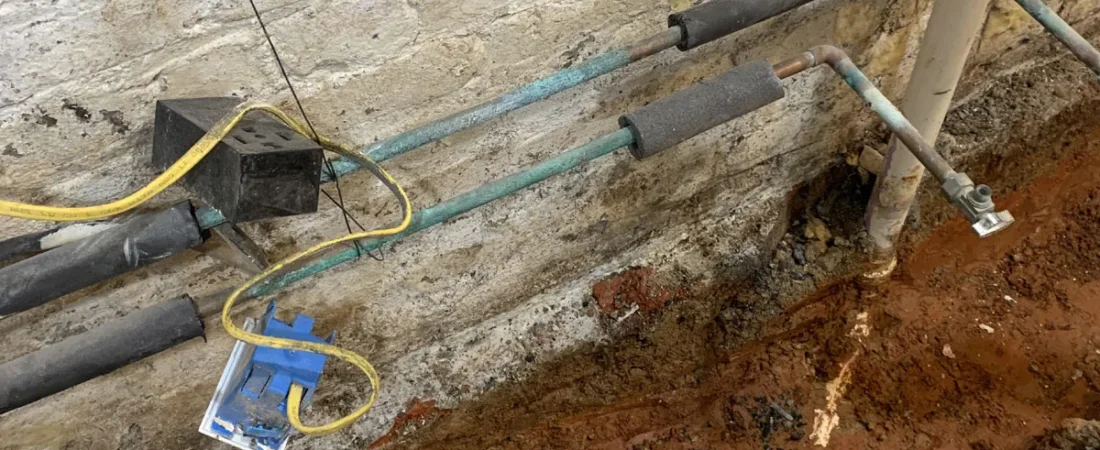
You notice a hairline crack in the basement wall. A water stain that was not there last spring. A damp line along the floor after a storm. The crack and the stain are symptoms. The cause is usually invisible, sitting in the soil on the other side of the wall: hydrostatic pressure.
What hydrostatic pressure is
Water has weight. When the soil around your foundation becomes saturated, the water in it presses against everything it touches, and the deeper the water, the greater the pressure. A basement wall eight feet below grade with saturated soil behind it is holding back a real load, and that load pushes water through the smallest opening it can find.
The pressure acts in two directions. It pushes sideways against the walls, and it pushes upward against the underside of the slab. That is why water can appear in the middle of a basement floor with no crack in sight: it is being forced up through the concrete itself.
Why it is so common in DC and Maryland
Washington, DC and the Maryland suburbs sit largely on clay. Clay holds water instead of letting it drain through, so after a heavy rain the ground next to your foundation stays saturated for days. Flat lots, downspouts that dump at the foundation, and a seasonal water table that rises in spring all add to the load.
Older homes make it worse. Many were built with no footing drain at all, or with clay tile drains that collapsed decades ago. Block and brick foundations are porous, and the cove joint where the wall meets the floor was never designed to hold back standing water.
How the water gets in
- The cove joint, where the wall sits on the footing and the slab butts against it, is the most common entry point we see
- Mortar joints in block walls absorb water and let it weep through to the interior face
- Hairline cracks from settling or shrinkage become channels under pressure
- Pores in old, unsealed concrete let water migrate straight through the wall
- Pipe penetrations, window wells, and old coal chutes leave gaps around the opening
- Floor cracks and the slab itself pass water when the pressure underneath is high enough
The damage it does over time
In the short term, hydrostatic pressure means wet floors, ruined belongings, and mold in the framing and drywall. Over years, water moving through masonry leaves white mineral deposits called efflorescence, flakes the surface of block and concrete, and feeds freeze-thaw damage near grade. In the worst cases, sustained pressure on a long block wall can push it inward.
We repair minor cracks as part of our waterproofing work. A wall that is actually bowing is a structural problem, and we will tell you so and point you to a structural contractor rather than cover it up with a drain.
Relieving the pressure
You cannot stop the rain or change the soil, but you can give the water an easier path than through your wall. That is the entire idea behind drainage-based waterproofing, and it works from either side of the foundation.
From the outside
Exterior waterproofing excavates to the footing, repairs the wall, applies a membrane and dimple drain board, and installs a footing drain in washed gravel. Water that reaches the wall drops down the drain board to the pipe and is carried away before it can build any pressure. The wall itself stays dry.
From the inside
An interior French drain cuts a trench along the slab edge, sets perforated pipe in gravel, and lines the base of the wall with dimple board that catches wall seepage and directs it down into the trench. The pipe carries everything to a sump basin and the pump sends it outside. The pressure is relieved at the exact point where water was entering.
From the yard
Grading corrections, downspout extensions, and yard drains reduce how much water reaches the foundation soil in the first place. They do not replace a drain system when water is coming up from below, but they lower the load on everything else.
Why sealants alone fail
Waterproof paints and injected sealants treat the opening, not the pressure. Block one path and the water finds the next weakest one, often a few feet away. Coatings applied on the inside of a wall are also fighting pressure from behind, which is why they blister and peel within a few seasons. Relieving the pressure is the only approach that holds up over decades.
Find the source first
Every job we do starts with a diagnosis: where the water is coming from, how it is getting in, and how much of it there is. From there we explain your options and the outcome you should expect from each. Request an inspection if your basement is showing the signs, and remember that when the drain work is done, SD Restorations puts the finished space back together, so the fix does not leave you with a torn-up room.